
Tier on Tier Shutters vs Full Height with Divider Rail
13th September 2019
7 min read
13th September 2019
7 min read
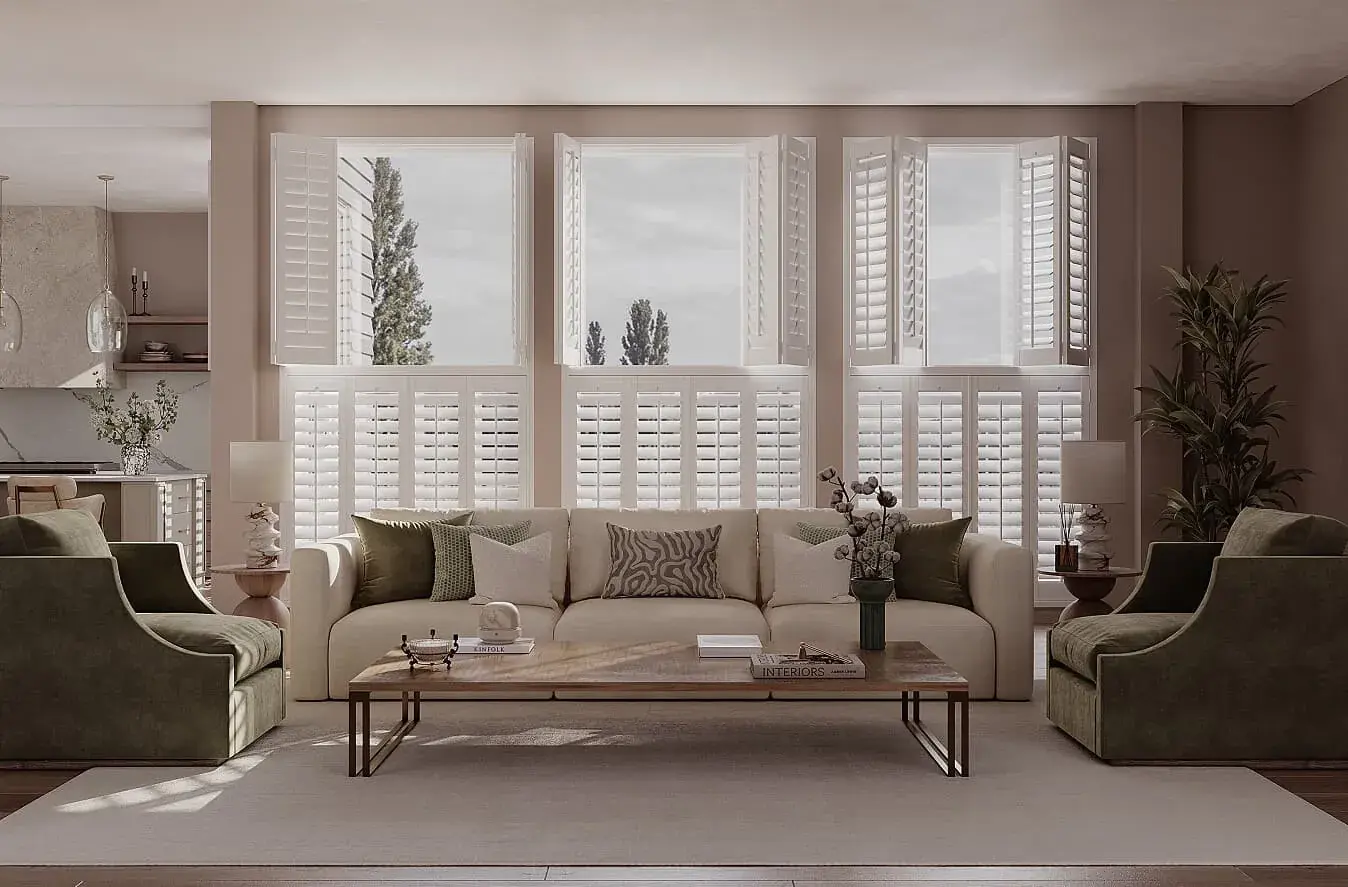
Shutters offer a few big advantages over blinds, shades, and curtains — better insulation and greater control over how much light enters the room. In addition, shutters can be divided to offer privacy in the lower part of your windows while allowing light to come in through the top.
Tier on tier shutters and full height shutters with a divider rail (mid-rail) are two popular options for achieving this. Here we explore the pros and cons of each style and why you might choose one over the other.
Tier on tier shutters have two sets of panels, upper and lower, that operate independently from one another.
Keep the lower tier panels closed for privacy while the top tier panels remain open for full light entry
If furniture or a kitchen faucet blocks the bottom of the window opening, you can still operate the upper section of your shutters freely
Keep the bottom tier panels open if you need access to your windowsill or perhaps an air conditioning unit in the window, and keep the top tier closed as needed
A great option for windows that face a busy street or directly point toward a neighbor's house
Best suited to windows that are less than approximately 60" x 60". For wider windows, gravity can work against the top tier panels over time
Because our shutters are 100% solid, the panels have a substantial weight that can cause the top tier to sag over the bottom
Additional adjustments can be required to keep the panels aligned, such as tightening or adjusting the hinges and using hinge shims
For first-time installers, tier on tier can be more challenging than other styles
If the window is too small, too many panels can look cluttered. You generally want at least 20" height for each tier, and at least 10" to 12" wide panels for an aesthetically pleasing result
Not currently available in our American or Express American ranges
For larger windows, we may suggest full height shutters, or adding T-posts to split the window into more manageable sections to prevent long-term issues with panel weight and alignment.
Adding a mid-rail (also known as a divider rail) to your full height shutters allows you to operate the slats separately above and below the mid-rail.
[H3] Pros of Full Height Shutters with a Mid-Rail
Control the amount of light and privacy independently in the upper and lower sections of the window
Keep the lower slats closed to block visibility into the home while keeping the upper slats open to allow light entry
Keep both sections open for full light entry, or closed for full privacy and light blockage
Use a mid-rail for aesthetic purposes — line it up to match an existing divide in your double hung windows, or to conceal a lock, handle, or alarm sensor
Full height shutters are the easiest style to install. With full support of a 4-sided frame, the panels stay aligned and closed with ease
More stable than tier on tier for larger windows and patio doors
A mid-rail adds structural support to a tall shutter to prevent warping or bowing
You can even add more than one mid-rail for very tall windows and have separate control over 3 sections of slats
Available in all 8 of our product ranges, including our Express ranges manufactured in as little as 2 weeks
The entire panel swings open as one unit from top to bottom, so you cannot open the upper and lower panel sections separately the way you can with tier on tier
Depending on the slat size and window height, the mid-rail position may need to be adjusted slightly (up or down about half a slat width). If you need an absolutely precise divide point, tier on tier allows customisation down to the 1/8th of an inch
There is no right or wrong answer when it comes to your custom shutters. Every window and project are unique, which is why our shutter experts are trained to advise on a case-by-case basis.
As a general guide:
Choose tier on tier if you want to open the upper and lower sections of your panels independently, and your window is a suitable size
Choose full height with a mid-rail if you want independent slat control without splitting the panels, or if your window is large and you want the easiest possible installation
Check out our Shutter Styles Guide